KRAS StripAssay
The Viennalab KRAS XL StripAssay detects 29 mutations in the KRAS gene, in codons 12, 13, 59, 60, 61, 117 and 146. KRAS mutations make anti-EGFR therapy ineffective in metastatic colorectal cancer, so the result is used to select patients for treatment with cetuximab or panitumumab. The procedure has three steps: DNA isolation, PCR amplification and reverse hybridisation on a test strip. One kit covers 20 tests.
 Automate on
DYNABLOT Heat
See the instrument that automates this assay
Automate on
DYNABLOT Heat
See the instrument that automates this assay
Quote-based, no public pricing. Add to your quote and our specialists put together a proposal with the right documentation, typically within 24 hours.
This kit in detail
- 29 KRAS mutations in codons 12, 13, 59, 60, 61, 117 and 146
- Patient selection for cetuximab and panitumumab
- Three steps: DNA isolation, PCR amplification, hybridisation
- Suitable for DNA from formalin-fixed paraffin-embedded (FFPE) tissue
- Reverse hybridisation on a test strip with colour reaction
- 20 tests per kit
The Viennalab KRAS XL StripAssay detects mutations in the KRAS gene in patients with metastatic colorectal cancer, in order to establish whether anti-EGFR therapy can be effective.
Why KRAS matters for anti-EGFR therapy
Monoclonal antibodies against the epidermal growth factor receptor (EGFR) block signalling through that receptor. KRAS lies downstream of EGFR in the MAPK signalling pathway. A mutation in KRAS activates the pathway permanently, which cancels the inhibitory effect of the antibody. Genetic screening for these mutations therefore determines whether a patient is eligible for cetuximab or panitumumab.
Mutations covered
The assay covers 29 mutations, distributed over codon 12 (8 mutations), codon 13 (6), codon 59 (3), codon 60 (1), codon 61 (5), codon 117 (3) and codon 146 (3).
Sample material
The assay is used on DNA from formalin-fixed paraffin-embedded (FFPE) tissue among other sources. Note that DNA from FFPE tissue cannot be reliably quantified by UV photometry: measurement at 260 nm substantially overestimates the amount of usable template, so a fluorometric method is required for quantification.
Method
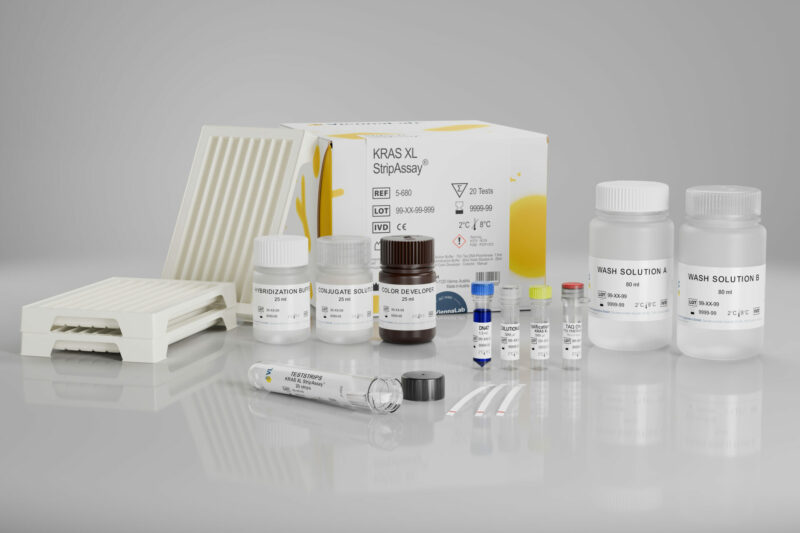
The procedure has three steps: isolation of DNA, PCR amplification of the KRAS region, and hybridisation of the product to probes immobilised on a test strip, followed by a colour reaction. The kit contains the amplification mix, Taq DNA polymerase and dilution buffer, DNAT, typing trays, 20 test strips, hybridisation buffer, wash solutions, conjugate solution, colour developer and a collector sheet.
- Amplification Mix (500 µl)
- Taq Dilution Buffer (500 µl)
- Taq DNA Polymerase (75 U)
- DNAT (1.5 ml)
- Typing Trays (3)
- Teststrips (20)
- Hybridization Buffer (25 ml)
- Wash Solution A (80 ml)
- Wash Solution B (80 ml)
- Conjugate Solution (25 ml)
- Color Developer (25 ml)
- Collector™ Sheet
Datasheets and regulatory documentation
Everything your quality team needs for evaluation and procurement.
Instructions for Use
Brochure StripAssays
Frequently paired with this kit
Other assays and instruments lab teams add alongside the KRAS StripAssay.


Add this kit to your quote
Tell us the platforms and throughput you’re planning for and our specialists will put together a clear proposal with the right documentation, no public pricing, just a considered answer.