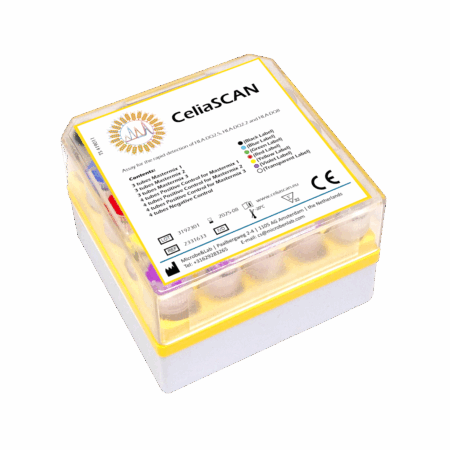
CeliaSCAN HLA-DQ2.5, HLA-DQ2.2 and HLA-DQ8 Assay
CeliaSCAN is an easy to use multiplex real-time PCR Assay and Melting Curve Analysis for the in vitro detection of strongly Celiac Disease-associated human leukocyte antigen (HLA)-DQ2.5, HLA-DQ2.2, and HLA-DQ8.
Quote-based, no public pricing. Add to your quote and our specialists put together a proposal with the right documentation, typically within 24 hours.
This kit in detail
- Fast and accurate assay with a turnaround time of 90 minutes
- Sensitivity and specificity of ~100%
- Distinction can be made between HLA DQ2.2 and HLA DQ2.5.
- Distinction between HLA DQ2.5 homozygotes from HLA DQ2.5 heterozygotes.
- Online software tool for the analysis of the results, therefore human interpretation of results is no longer necessary
Celiac disease
Celiac Disease is an autoimmune disease caused by an inappropriate immune response to dietary gluten. 90% of patients with celiac disease express the HLA-DQ2.5 heterodimer. Of the remaining 10% most carry the HLA-DQ8 or HLA-DQ2.2 heterodimers.
Absence of these heterodimers is a very strong negative predictor of celiac disease.
The worldwide prevalence of celiac disease is approximately 1%, however most CD remains undetected.
- Celiac disease (CD) is an autoimmune disease, where individuals develop an intolerance to gluten (wheat, barely, rye), presenting with or without symptoms such as chronic diarrhoea, nutritional malabsorption, weight loss, unexplained iron deficiency anaemia, osteoporosis or neurological symptoms
- Worldwide diagnostic prevalence ~1%, however, since most CD cases go undetected, the expected worldwide prevalence ~8%
- Treatment with strict and lifelong gluten-free diet (GFD)
HLA facts
90% of patients with celiac disease express the HLA-DQA1*05, HLA-DQB1*02 heterodimer (HLA-DQ2.5). Of the remaining 10% most carry the HLA-DQA1*03, HLA-DQB1*03:02 heterodimer (HLA-DQ8). Some of the patients with celiac disease express the HLA-DQA1*02, HLA-DQB1*02 heterodimer (HLA-DQ2.2).
Absence of these haplotypes is a strong negative predictor of celiac disease.
Individuals homozygous for HLA-DQ2.5 have the highest genetic risk for celiac disease.
Intended use
The CeliaSCAN HLA-DQ2.5, HLA-DQ2.2 and HLA-DQ8 Assay is intended to be used for in vitro detection of the MHC class II HLA-DQ2.5 (hetero- and homozygous), HLA-DQ8, HLADQ2.2 and HLA-DQA1*05 markers in human DNA, with the aim to exclude Celiac disease as a diagnosis. There is no need of any specific information to be provided. The CeliaSCAN Assay is a non-automated qualitative assay, meaning it detects whether the above mentioned alleles are present or not. CeliaSCAN uses genomic DNA derived from any human sample using any DNA isolation method as input material and is suitable for all populations and not intended for companion diagnostics.
Summary and explanation of the test
Celiac disease (CD) is an autoimmune disease characterized by chronic diarrhoea, inflammatory lesions in the small bowel, villous atrophy, nutritional malabsorption and occasionally neurological symptoms. Once thought to be a rare disease, CD is increasingly being diagnosed and currently has a worldwide prevalence of 1%. Gluten, the primary component of wheat, rye and barley, is the environmental agent responsible for CD. Ninety per cent of CD patients express the human leukocyte antigen (HLA)-DQA1*05, HLA-DQB1*02 heterodimer (HLA-DQ2.5). Of the remaining 10% most carry the HLA-DQA1*03, HLA-DQB1*03:02 heterodimer (HLA-DQ8). A small minority of CD patients carries only HLA-DQA1*05 or HLA-DQB1*02 (usually on the HLA-DQA1*02 – HLA-DQB1*02 haplotype (HLA-DQ2.2). Individuals with the highest risk for developing CD are those homozygous for HLA-DQA1*05 – HLA-DQB1*02 (HLA-DQ2.5 homozygotes).
CeliaSCAN HLA-DQ2.5, HLA-DQ2.2 and HLA-DQ8 Assay kit is an easy and ready to use real-time 96-well PCR assay and melting curve analysis that combines speed and accuracy. It provides 100% sensitivity and specificity.
Principle of the test procedure
The detection of HLA-DQ2.5, HLA-DQ2.2, HLA-DQ8 and HLA-DQA1*05 markers by PCR is based on the amplification of allele specific parts in exon 2 of both the HLA-DQA1 and HLA-DQB1 genes. Six primer pairs detect the DQA1*02, DQA1*03, DQA1*05, DQB1*02, DQB1*0302 and DQ2.5 homozygous SNP alleles needed to successfully genotype for DQ2 and DQ8. Two more additional primer pairs detect monomorphic parts of the HLA-DRA and HLA-F genes and serve as amplification and temperature shift controls.
In the real-time PCR melting analysis method, amplification of these specifically selected sequences of DNA is detected by measurement of the SYBR® GreenER™ fluorescence signal. Because SYBR Green is incorporated into all double-stranded DNA, a melting curve must be performed to determine if the correct alleles have been amplified. The melting curve is performed after the completion of PCR by slowly heating the reaction to 97ºC, which causes melting of the double-stranded DNA and a corresponding sharp decrease of SYBR® GreenER™ fluorescence is seen. The instrument continuously monitors this fluorescence decrease and displays it as melting peaks. Each melting peak represents the characteristic melting temperature, Tm, of a particular DNA product (where the DNA is 50% double-stranded and 50% single-stranded). The Tm is determined at the inflection point of the melting curve. Thus the presence of the desired-specific PCR product in a given sample will be indicated by its primer-specific Tm.
CeliaSCAN workflow
- Collect a sample
- Isolate DNA
- Perform PCR & Melting-curve analysis
- Online report in seconds
- Follow up if necessary
CeliaSCAN HLA-DQ2.5, HLA-DQ2.2 and HLA-DQ8 Assay kit test procedure
This procedure must be performed in the Pre-Amplification Preparation Area. Use aerosol resistant pipette tips during the whole test procedure. The procedure may only be carried out by trained laboratory personnel. Any deviations from this procedure may result in failure of the assay or incorrect results.
- In the 96-well format prepare reactions in the required number of wells for the number of specimens to be measured, plus one well for the positive control (PC) and one well for the negative template control (NC).
- Add 15 µl of mastermix1, mastermix2 and mastermix3 to each reaction according to the scheme below.
- Vortex and spin down all DNA sample. Carefully open the tubes with the DNA solution one by one and avoid contamination of gloves and pipette. Using a new aerosol resistant pipette tip add 5 µl of each DNA sample (20 ng/µl) to the reaction tube/well containing the master mix. N.B. Replace gloves if suspected of contamination.
- Using a new aerosol resistant pipette tip, add 5 µl of the positive and negative control (PC and NC respectively) to the designated reaction tubes/wells containing the master mix.
- Seal the plate, spin down and take the plate to the Amplification Area.
- Load the reaction plate into the real-time PCR instrument. Run protocols and templates for each machine and software version can be downloaded at www.microbe-lab.com/celiascan
- Load the appropriate run protocol for your machine and software version, fill in the sample names and start your run.
Note: It is very important that samples and controls are pipetted in the exact positions as shown in the above scheme. PC’s should always be at positions G4, G8 and G12. NC’s should always be at positions H4, H8 and H12.
The 96-well pipetting scheme referred to above and the instrument-specific run settings are provided in the Instructions For Use (see Downloads).
Specifications
- Method: Multiplex real-time PCR and Melting Curve assay
- Detection: Detection by SYBR Green
- Tests per kit: 32 tests per kit
- Turnaround time: Fast (1.5 hours Assay including Analysis & Reports)
- Performance: In-house comparison with SSCP method (n=166): Sensitivity ~100%, Specificity ~100%
- Amplification: Simultaneous amplification of allele specific parts in exon 2 of both the HLA-DQA1 and HLA-DQB1 genes
- Primers: 6 primer pairs detect 6 alleles in 3 reactions
- Controls: Two additional primer pairs detect monomorphic parts of the HLA-DRA and HLA-F genes and serve as amplification controls
- Allele discrimination: Distinguishes: HLA-DQ2.2 from HLA-DQ2.5, HLA-DQ2.5 homozygotes from HLA-DQ2.5 heterozygotes
- Analysis: Automated analysis of results by online analysis software
- Sample material: The CeliaSCAN HLA-DQ2.5, HLA-DQ2.2 and HLA-DQ8 Assay is intended to be used on genomic DNA samples. Commercial DNA extraction kits, such as the Roche High Pure PCR Template Preparation Kit, can be used to obtain genomic DNA from any human cell specimen. No commercial DNA extraction kit is provided with CeliaSCAN. For optimal performance it is recommended that DNA samples are diluted to a concentration of 20 ng/µl.
- Compatible platforms: Roche LightCycler® 480, Applied Biosystems® 7500 Real-Time PCR Systems, Applied Biosystems® QuantStudio™ 5 Real-Time PCR system, BioRad CFX96 real-time PCR
- Additional required materials: Use sterile DNase-free polypropylene disposables for all steps in the procedure: Filter Tips, 96-well PCR plate, Optical Seal.
- Storage: Store at -20ºC upon receipt. Store all components at or below -20°C or at 2°C–8°C when the kit will be used again within 7 days. All components are temperature sensitive. SYBR green is light sensitive, so store all kits and mastermixes in a dark area when not in use.
- Kit contents (Regular, 32 reactions): 3x MasterMix1, 3x MasterMix2, 3x Mastermix3, 4x Positive Control for each MasterMix, 4x Negative Control
- Weight: 1 kg
- Dimensions: 7.5 × 7.5 × 5.2 cm
- Regulatory status: CE-IVDD Certified since July 2017, CE-IVDR expected in 2026, Indian FDA granted in October 2025
Limitations of the procedure
- Optimal performance of the test requires good quality DNA and correct sample setup. (see 4.3. Specimen collection and preparation of DNA samples and 5.2. CeliaSCAN HLA-DQ2.5, HLA-DQ2.2 and HLA-DQ8 Assay kit test procedure).
- All instruments must be calibrated according to manufacturer’s instructions.
- The CeliaSCAN assay has been validated for use with the Roche LightCycler ® 480 series, the Applied Biosystems® 7500 Real-Time PCR series and the Biorad CFX96 series. Do not use any other Real-Time PCR machines.
- Good laboratory practices and strict adherence to these Test Instructions are indispensable to avoid contamination of reagents and/or DNA.
- The user should have a laboratory education in PCR techniques or have gained appropriate experience in the field of PCR techniques.
- CeliaSCAN is a low resolution HLA-DQ typing assay. Because of a large number of rare alleles, not all allele combinations can be resolved. Below is a list of all detectable alleles by CeliaSCAN.
- CeliaSCAN is not intended to diagnose Celiac Disease.
- MasterMix1 – 3 tubes with a black colour code, labelled “MasterMix1” each containing 200 µl ready to use PCR mix. This mixture contains eight primers for amplification of HLA-DQA1*02, HLA-DQA1*03, HLA-DQB1*02 and HLA-F control. It contains the SYBR® GreenER™ intercalating dye for detection of double stranded DNA. The master mix contains all ingredients for PCR amplification including Taq polymerase.
- MasterMix2 – 3 tubes with a blue colour code, labelled “MasterMix2” each containing 200 µl ready to use PCR mix. This mixture contains six primers for amplification of HLA-DQA1*05, HLA-DQB1*0302 and HLA-DRA control. It contains the SYBR® GreenER™ intercalating dye for detection of double stranded DNA. The master mix contains all ingredients for PCR amplification including Taq polymerase.
- MasterMix3 – 3 tubes with a green colour code, labelled “MasterMix3” each containing 200 µl ready to use PCR mix. This mixture contains four primers for amplification of HLA-DQ2.5 homozygous SNP and HLA-DRA control. It contains the SYBR® GreenER™ intercalating dye for detection of double stranded DNA. The master mix contains all ingredients for PCR amplification including Taq polymerase.
- Negative Control – 4 tubes with a transparent colour code, labelled ”Negative Control” each containing 200 µl negative template control.
- Positive Control MM1 – 4 tubes with a red colour code, labelled ”Positive Control MM1” each containing 20 µl positive control for MasterMix1, a synthetic double stranded oligonucleotide containing the DNA sequences for HLA-DQA1*02, HLA-DQA1*03, HLA-DQB1*02 and the HLA-F control.
- Positive Control MM2 – 4 tubes with a yellow colour code, labelled ”Positive Control MM2” each containing 20 µl positive control for MasterMix2, a synthetic double stranded oligonucleotide containing the DNA sequences for HLA-DQA1*05, HLA-DQB1*0302 and the HLA-DRA control.
- Positive Control MM3 – 4 tubes with a purple colour code, labelled ”Positive Control MM3” each containing 20 µl positive control for MasterMix3, a double stranded oligonucleotide containing the DNA sequences for the HLA-DQ2.5 homozygous SNP and the HLA-DRA control.
Note: Use all components of the same kit lot number.
Datasheets and regulatory documentation
Everything your quality team needs for evaluation and procurement.
Product documentation
Run protocols and templates
Analysis software
Frequently paired with this kit
Other assays and instruments lab teams add alongside the CeliaSCAN HLA-DQ2.5, HLA-DQ2.2 and HLA-DQ8 Assay.

Add this kit to your quote
Tell us the platforms and throughput you’re planning for and our specialists will put together a clear proposal with the right documentation, no public pricing, just a considered answer.