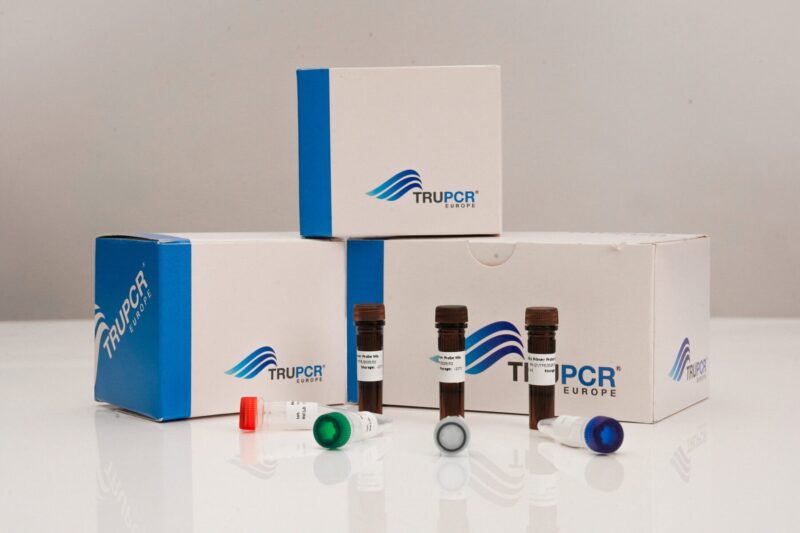
ESBL & Carbapenem Resistance Detection Kit, tap a thumbnail to see more views.
ESBL & Carbapenem Resistance Detection Kit
The TRUPCR® ESBL & Carbapenem Resistance Detection Kit is an in vitro real-time PCR assay designed for the qualitative detection and differentiation of antimicrobial resistance genes associated with extended-spectrum β-lactamase (ESBL) production and carbapenem non-susceptibility. The assay targets eight clinically relevant gene families: blaCTX-M group 1, blaTEM, blaSHV, blaKPC, blaNDM, blaVIM, blaOXA-48-like, and blaIMP. These markers represent the most commonly encountered molecular mechanisms underlying ESBL and carbapenem resistance in Gram-negative bacteria. The kit uses multiplex primer–probe mixes and TaqMan® chemistry to allow simultaneous amplification of multiple targets across three separate reactions. An endogenous internal control is included in each tube to verify amplification performance and identify potential PCR inhibition. All reagents, including positive and negative controls, are supplied ready-to-use to support standardized testing workflows. The assay is validated on widely used real-time PCR instruments and offers a limit of detection of 10 copies per reaction, providing a reliable molecular tool for resistance gene screening in clinical microbiology laboratories. For Research Use Only (RUO)
Quote-based, no public pricing. Add to your quote and our specialists put together a proposal with the right documentation, typically within 24 hours.
This kit in detail
- Multiplex real-time PCR detection of blaCTX-M gr1, blaTEM, blaSHV, blaKPC, blaNDM, blaVIM, blaOXA-48-like and blaIMP.
- Differentiation of ESBL and carbapenemase gene families within the same workflow.
- Limit of detection of 10 copies per reaction with integrated internal control monitoring.
- Ready-to-use reagents and validated performance across commonly used real-time PCR platforms.
TRUPCR® ESBL & Carbapenem Resistance Detection Kit
The TRUPCR® ESBL & Carbapenem Resistance Detection Kit is a real-time PCR assay developed for the qualitative detection and differentiation of key antimicrobial resistance genes associated with extended-spectrum β-lactamase (ESBL) production and carbapenem non-susceptibility. The panel targets eight gene families that represent the most frequently encountered molecular mechanisms underlying β-lactam resistance in Gram-negative bacteria. The assay provides a standardized workflow suitable for routine molecular testing in clinical microbiology settings.
Clinical Relevance of Carbapenemase Genes
Extended-spectrum β-lactamases and carbapenemases contribute to reduced susceptibility to broad-spectrum β-lactam antibiotics. The targeted ESBL-associated genes (blaCTX-M group 1, blaTEM, blaSHV) and carbapenemase-associated genes (blaKPC, blaNDM, blaVIM, blaOXA-48-like, blaIMP) encode enzymes capable of hydrolyzing penicillins, cephalosporins, and carbapenems to varying degrees. Molecular detection of these genes supports confirmation of underlying resistance mechanisms but does not replace phenotypic susceptibility testing. Results should be interpreted alongside culture findings, clinical status, and epidemiological information.
About the Assay
The assay uses multiplex primer–probe mixes formulated with TaqMan® chemistry to enable simultaneous amplification of multiple gene families across three reactions. Each tube contains an endogenous internal control to monitor for PCR inhibition and ensure that negative results are interpretable. The kit includes all required reagents, including qPCR mix, primer–probe mixes, PCR enhancer, and both positive and negative controls. Reagents are provided ready-to-use to minimize preparation time and support consistent assay performance.
Principle and Workflow
During real-time PCR amplification, primers anneal to target gene sequences, and fluorogenic probes hybridize to their complementary regions. Cleavage of these probes during polymerase extension releases fluorescent signal proportional to the amount of amplified genetic material. Each of the three reaction tubes corresponds to specific gene groups:
- Tube 1: ESBL genes (blaCTX-M gr1, blaTEM, blaSHV) + internal control
- Tube 2: Carbapenemase genes (blaKPC, blaNDM, blaVIM) + internal control
- Tube 3: Carbapenemase genes (blaOXA-48-like, blaIMP) + internal control
The workflow includes nucleic acid extraction, reaction setup using provided reagents, real-time amplification, and interpretation of fluorescence curves according to predefined thresholds. The internal control verifies PCR performance and assists in identifying potential inhibition or technical errors.
Clinical Application
The TRUPCR® ESBL & Carbapenem Resistance Detection Kit detects ESBL and carbapenemase gene families in extracted DNA from clinical specimens or cultured isolates. The assay is suitable for molecular screening workflows, resistance mechanism confirmation, and support of infection prevention and surveillance programs. Although the kit detects eight major gene families, a negative result does not exclude resistance mechanisms not included in the panel. All results should be evaluated in conjunction with phenotypic testing and broader clinical and laboratory data.
For Research Use Only (RUO)
Datasheets and regulatory documentation
Everything your quality team needs for evaluation and procurement.
Product Catalogus
Frequently paired with this kit
Other assays and instruments lab teams add alongside the ESBL & Carbapenem Resistance Detection Kit.
iCassette - 16 High Risk Human Papillomavirus, HPV 16, and HPV 18
Add this kit to your quote
Tell us the platforms and throughput you’re planning for and our specialists will put together a clear proposal with the right documentation, no public pricing, just a considered answer.