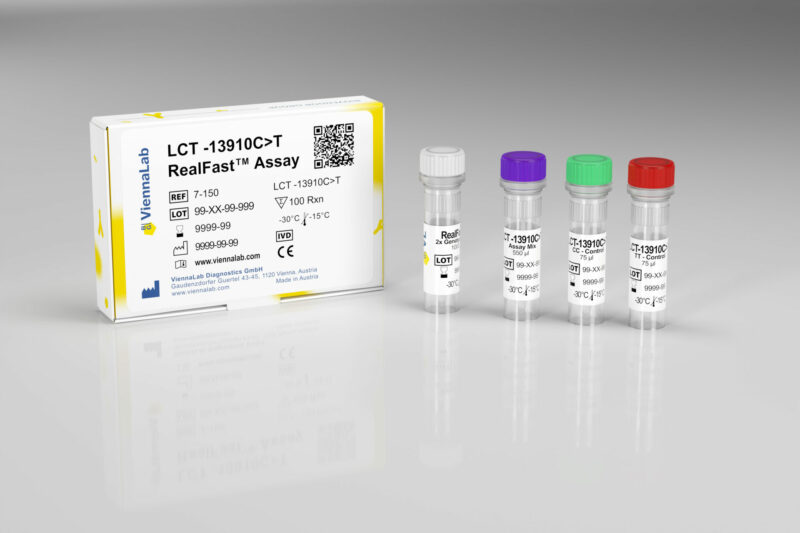
LCT-13910C>T PCR Assay
The Viennalab LCT -13910C>T RealFast Assay detects the -13910C>T variant in the regulatory region upstream of the lactase (LCT) gene and reports the three genotypes CC, CT and TT. The CC genotype corresponds to lactase non-persistence, the cause of adult-type hypolactasia and of the lactose intolerance that follows from it. CT and TT correspond to lactase persistence.
Quote-based, no public pricing. Add to your quote and our specialists put together a proposal with the right documentation, typically within 24 hours.
This kit in detail
- Detects LCT -13910C>A (g.9094C>T, rs4988235)
- Reports the CC, CT and TT genotypes
- CC corresponds to lactase non-persistence
- Real-time PCR with allele-specific hydrolysis probes, 108 bp amplicon
- CC-Control and TT-Control supplied
- 32 or 100 reactions per kit, REF 7-153 and REF 7-150
The Viennalab LCT -13910C>T RealFast Assay determines the genotype of the variant that decides whether lactase production continues into adulthood.
Clinical background
Lactase breaks down lactose, the sugar in milk. In most of the world’s population lactase production falls after weaning, which is the normal state and is called lactase non-persistence. The undigested lactose then causes bloating, cramps and diarrhoea. A variant in the regulatory region upstream of the LCT gene keeps lactase production going: carriers of the T allele remain able to digest lactose as adults.
Interpretation
The assay reports three genotypes. CC corresponds to lactase non-persistence, so an intolerance complaint fits the genotype. CT and TT correspond to lactase persistence, in which case the complaints have another cause, which is what makes the test useful in the differential diagnosis of irritable bowel complaints.
Method
The assay is a real-time PCR based on the 5′ nuclease principle. A 108 bp fragment is amplified and read with two allele-specific hydrolysis probes: FAM for the T allele and HEX for the C allele. The kit supplies the RealFast 2x Genotyping Mix, the LCT -13910C>T Assay Mix, a CC-Control and a TT-Control; a heterozygous control is prepared by mixing the two 1:1. The recommended DNA input is 10 to 100 ng per reaction at 2 to 20 ng/µl, and the limit of detection is 0.2 ng of genomic DNA per reaction. DNA isolated from whole peripheral blood, dried blood spots, buccal swabs or saliva can be used, and DNA extraction reagents are not supplied with the kit.
- PCR mix: The PCR mix is a ready-to-use solution that contains Taq polymerase, dNTPs, and other PCR components necessary for the amplification of DNA.
- Primers: The kit contains specific primers that target the LCT-13910C>T variant.
- Positive control: The kit includes a positive control that contains DNA with the LCT-13910C>T variant, ensuring that the assay is working correctly.
- Negative control: The kit also includes a negative control that contains no DNA, allowing for the detection of potential contamination.
- DNA extraction kit: Depending on the type of sample, the kit may also include a DNA extraction kit for the isolation of DNA from the sample.
Datasheets and regulatory documentation
Everything your quality team needs for evaluation and procurement.
Instructions for Use
Frequently paired with this kit
Other assays and instruments lab teams add alongside the LCT-13910C>T PCR Assay.

Add this kit to your quote
Tell us the platforms and throughput you’re planning for and our specialists will put together a clear proposal with the right documentation, no public pricing, just a considered answer.