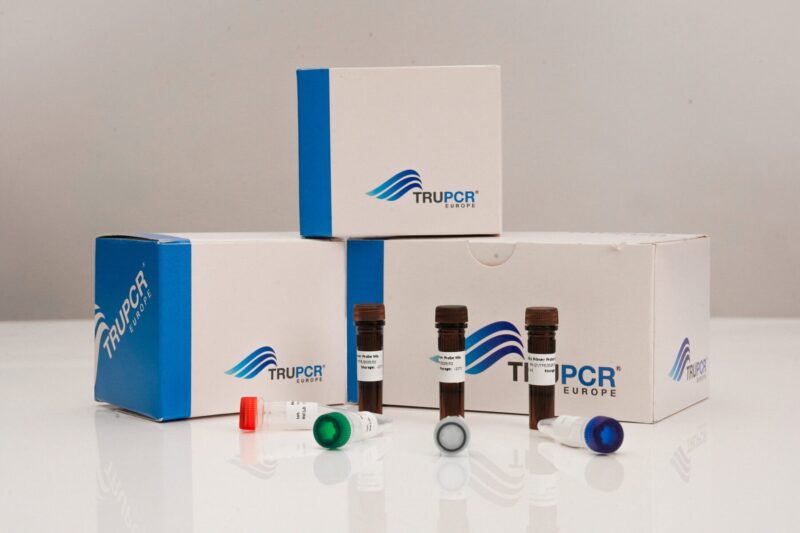
Rif INH MTB Drug Resistant Detection Kit, tap a thumbnail to see more views.
Rif INH MTB Drug Resistant Detection Kit
The TRUPCR® Rif/INH MTB Drug Resistant Detection Kit is a real-time nested PCR assay designed for the qualitative detection of Mycobacterium tuberculosis complex (MTBC) and the determination of rifampicin and isoniazid resistance or susceptibility. The kit uses four reaction tubes: one dedicated to MTBC detection and three targeting mutations associated with multi-drug resistance. Detection of resistance is based on seven probes that interrogate defined regions of the rpoB gene (81-bp core region), the katG gene, and the inhA promoter region. Each reaction is multiplexed and uses fluorescent probes to differentiate among targets via FAM/Green, HEX/Yellow, and Texas Red/Orange channels. An internal control is included in every tube to monitor PCR inhibition. The nested PCR design enhances sensitivity for both pulmonary and extrapulmonary samples. The assay incorporates hot-start enzyme technology and uracil-DNA glycosylase (UDG) to reduce non-specific amplification and minimize carryover contamination. With limits of detection of 10 CFU/ml for MTBC and 120 CFU/ml for resistance markers, the kit provides a standardized workflow for molecular detection of MTBC and associated drug resistance.
Quote-based, no public pricing. Add to your quote and our specialists put together a proposal with the right documentation, typically within 24 hours.
This kit in detail
- Nested real-time PCR detection of MTBC and Rif/INH resistance markers
- Targets rpoB, katG, and inhA promoter mutations using seven probes
- Hot-start polymerase and UDG included to enhance specificity and prevent contamination
- Compatible with multiple real-time PCR platforms and validated for diverse sample types
TRUPCR® Rif/INH MTB Drug Resistant Detection Kit
The TRUPCR® Rif/INH MTB Drug Resistant Detection Kit is an in vitro nucleic acid amplification assay intended for the qualitative detection of Mycobacterium tuberculosis complex (MTBC) and for determining rifampicin and isoniazid resistance or susceptibility. The kit uses real-time nested PCR to enhance analytical sensitivity and integrates four reaction tubes: one for MTBC identification and three for mutation analysis associated with drug resistance. The assay is designed for use with DNA extracted from a variety of clinical specimens.
Clinical Relevance of MTBC Drug Resistance Targets
Resistance to rifampicin and isoniazid is strongly associated with mutations in specific genomic regions of MTBC. Mutations in the 81-bp core region of the rpoB gene (codons 507–533) account for the majority of rifampicin resistance. Isoniazid resistance typically involves changes in the katG gene (most frequently at codon 315) or the inhA promoter region (positions –5, –8, –15, –16). The kit includes seven probes designed to interrogate these regions. Detection of mutations indicates potential resistance but does not substitute for phenotypic drug susceptibility testing. Results should be interpreted within the context of additional microbiological and clinical data.
About the Assay
The assay applies multiplex real-time PCR using fluorescent hydrolysis probes to detect both MTBC DNA and specific mutations associated with resistance. Each reaction tube contains an internal control to assess PCR performance and identify potential inhibition. The nested PCR format provides increased sensitivity for samples with low bacterial load. Hot-start polymerase minimizes non-specific amplification, while UDG in the master mix helps prevent carryover contamination. The kit is supplied with all necessary reagents, allowing standardized implementation in routine molecular workflows.
Principle and Workflow
During nested real-time PCR, target DNA is amplified through two successive stages within the same reaction setup, increasing the likelihood of detecting low-copy targets. Fluorescent probes bind to their respective gene segments; probe cleavage during polymerase extension generates measurable fluorescence proportional to the amplified DNA.
Five probes interrogate the rpoB hotspot region, while one probe each targets katG and the inhA promoter. Resistance is inferred when probe dropout or ΔCt values exceed defined thresholds. Susceptibility is supported when all probes amplify within expected Ct differences.
The workflow includes DNA extraction, reaction preparation, amplification across four tubes, and interpretation of fluorescence profiles. The integrated internal control validates each reaction for sample adequacy and inhibition.
Clinical Application
The kit is intended for molecular detection of MTBC and associated resistance to rifampicin and isoniazid in pulmonary and extrapulmonary samples. Applications include initial screening, rapid assessment of drug resistance markers, and support for tuberculosis management programs. While the assay detects genetic determinants of resistance, negative results do not exclude alternative mechanisms. All findings should be evaluated in combination with phenotypic testing and clinical information.
Datasheets and regulatory documentation
Everything your quality team needs for evaluation and procurement.
Product Catalogus
Frequently paired with this kit
Other assays and instruments lab teams add alongside the Rif INH MTB Drug Resistant Detection Kit.
Add this kit to your quote
Tell us the platforms and throughput you’re planning for and our specialists will put together a clear proposal with the right documentation, no public pricing, just a considered answer.