SCID-XLA mpx PCR Assay
The SCID-XLA mpx RealFast™ Assay is a non-automated real-time PCR test for the semi-quantitative detection of T-cell receptor excision circles (TREC) and kappa-deleting recombination excision circles (KREC) and beta-actin (ACTB) in a single reaction. TREC and KREC copy number determination is based on simultaneous detection and relative quantification of endogenous ACTB gene copies present in DNA extracted from fresh dried blood spot (DBS) samples from neonates on filter paper (Guthrie-cards).
Quote-based, no public pricing. Add to your quote and our specialists put together a proposal with the right documentation, typically within 24 hours.
This kit in detail
- Fluorogenic 5’ nuclease (TaqMan®) assay for TREC, KREC and beta-actin (ACTB) in a single reaction
- Semi-quantitative detection with relative quantification against endogenous ACTB gene copies
- For DNA extracted from fresh dried blood spot (DBS) samples from neonates on filter paper (Guthrie-cards)
- Validated for use with the Bio-Rad CFX 96, Bio-Rad CFX Opus 96, and Applied Biosystems Quantstudio 5 real-time PCR instruments
- Can be combined with the SMN1 RealFast™ Assay in one run
- 100 reactions in a final volume of 20 µl each
- Withstands up to 20 freeze/thaw cycles with no loss of activity
Reference sequences
- Beta-Actin (ACTB): Ref.Seq. NG_007992.1
- T-cell receptor excision circles (TRECs): Human T-cell receptor alpha delta locus: GenBank: AE000521.1
- Kappa-deleting recombination excision circles (KREC): Homo sapiens immunoglobulin kappa locus, proximal V-cluster and J-C cluster (IGK-proximal) on chromosome 2: NCBI Reference Sequence: NG_000834.1
Introduction
Primary immunodeficiencies (PIDs) are rare inherited disorders of the immune system. Most patients present with impaired T- and/or B-cell function, resulting in defective immunity. Among PIDs, severe combined immunodeficiency (SCID) represents a heterogeneous group of life-threatening disorders defined by the absence of functional T-cells. Apart from rare non-genetic SCID-like conditions, several distinct monogenic defects – most commonly inherited in an autosomal-recessive manner – account for the majority of SCID cases. SCID can be classified according to the underlying molecular pathology, including impaired cytokine-mediated signaling, defects in V(D)J recombination, impaired T-cell receptor (TCR) signaling, increased lymphocyte apoptosis, absence or abnormal development of the thymus, and impaired calcium flux, among others. In addition to the absence of naïve T cells, most SCID genotypes exhibit a characteristic immunophenotype defined by the presence or absence of B cells and natural killer (NK) cells, leading to a stratification into T-B-NK-, T-B+NK-, T-B-NK+, and T-B+NK+ subtypes. Of these, the T-B+NK- subtype accounts for up to 50% of cases. The thymus plays a central role in generating a diverse population of peripheral T cells.
B-cell development, by contrast, occurs in the bone marrow and depends on a complex signaling cascade. Disruptions of this process may cause maturational arrest in early B-cell development, leading to humoral immunodeficiency with decreased or absent antibody production. Among primary B-cell immunodeficiencies, X-linked agammaglobulinemia (XLA) accounts for up to 85% of agammaglobulinemia cases with a defined genetic etiology. The long-term prognosis of infants with SCID and other severe immunodeficiencies can be markedly improved by early diagnosis, ideally before the onset of severe infections. In this context, T-cell receptor excision circles (TRECs) and kappa-deleting recombination excision circles (KRECs) provide valuable diagnostic markers. These circular DNA byproducts are generated during the recombination processes that create T- and B-cell receptors. Quantification of TRECs and KRECs in peripheral blood serves as a surrogate measure of thymic and bone marrow output.
Storage and Stability
The SCID-XLA mpx RealFast™ Assay is shipped on cooling blocks. On arrival, store the kit at -30 to -15°C. Alternatively, store at 2 to 8°C for short-term use within one month. The kit withstands up to 20 freeze/thaw cycles with no loss of activity. Avoid prolonged exposure to intense light. If stored correctly, the kit will retain full activity until the expiration date indicated on the label.
Principle of the Test
The test is based on the fluorogenic 5’ nuclease assay, also known as TaqMan® assay. Each reaction contains gene-specific primer pairs that amplify a 82 bp fragment of the TREC sequence, a 87 bp KREC fragment and a 70 bp fragment of the ACTB gene. Further components are dual-labeled, sequence-specific hydrolysis probes (a Cy5-labeled TREC probe, a HEX-labeled KREC probe and a Cy5.5-labeled ACTB probe) that hybridize to the target sequence of the corresponding fragment. The proximity of the 5’-fluorescent reporter and 3’-quencher dye on intact probes prevents the reporter from fluorescing. During the extension phase of PCR, the 5’ – 3’ exonuclease activity of the Taq DNA polymerase cleaves the 5’-fluorescent reporter from the hybridized probe. The physical separation of the fluorophore from the quencher dye generates a fluorescent signal in real time, which is proportional to the accumulated PCR product.
The SCID-XLA mpx RealFast™ Assay is a semi-quantitative assay and infers the amount of all three nucleic acid targets by comparison to distinct standard curves obtained from serial dilutions of the SCID Control (TREC/ACTB/KREC plasmid). The ACTB gene serves as a reference for normalization of TREC and KREC levels.
Real-time PCR Instrument Compatibility
The SCID-XLA mpx RealFast™ Assay is validated for use with the Bio-Rad CFX 96, Bio-Rad CFX Opus 96, and Applied Biosystems Quantstudio 5 real-time PCR instruments. The SCID-XLA mpx RealFast™ Assay can be combined with SMN1 RealFast™ Assay. In this case, calibration of the realtime PCR device for Cy5.5, Cy5, HEX, FAM, and ROX is required. The kit is compatible with various common real-time PCR instruments capable of recording HEX, Cy5 and Cy5.5 fluorescence:
- AB QuantStudio 5 (Applied Biosystems)
- CFX96 (Bio-Rad)
- CFX Opus 96 (Bio-Rad)
Assay Performance Specifications
- The SCID-XLA mpx RealFast™ Assay is for research use only.
- Analytical performance data: currently not available.
- Limit of detection: data not available.
- Recommended DNA concentration: 0.2 to 10 ng/µl genomic DNA.
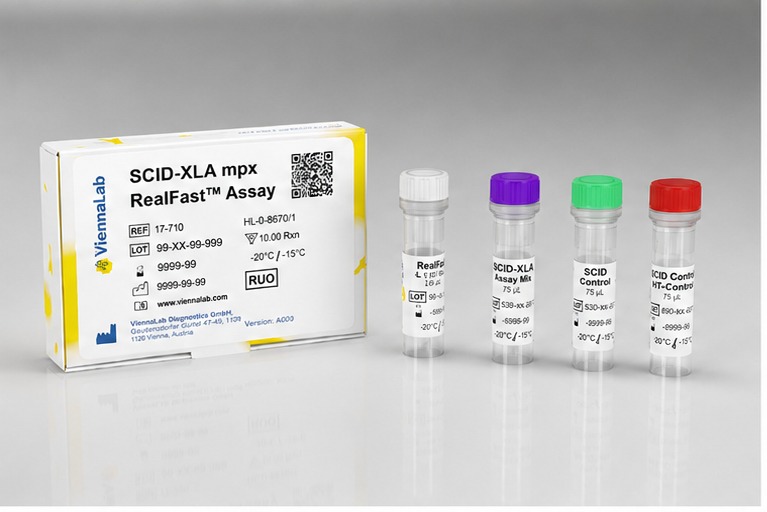
- RealFast™ 4x LIT-Mix: 1 vial, white cap, 550 µl
- SCID-XLA Assay Mix: 1 vial, purple cap, 275 µl
- SCID Control: 1 vial, green cap, 75 µl
- SCID Control Dilution Buffer: 3 vials, transparent cap, 75 µl
The RealFast™ 4x LIT-Mix comprises HotStart Taq DNA polymerase and dNTPs in an optimized buffer system. The SCID-XLA Assay Mix consists of gene-specific primers and dual-labeled hydrolysis probes for ACTB, TREC and KREC. SCID Control is a tripartite plasmid (TREC/ACTB/KREC) used to generate a standard curve.
The kit contains reagents for 100 reactions in a final volume of 20 µl each.
Datasheets and regulatory documentation
Everything your quality team needs for evaluation and procurement.
Instructions for Use
Brochure
Frequently paired with this kit
Other assays and instruments lab teams add alongside the SCID-XLA mpx PCR Assay.

Add this kit to your quote
Tell us the platforms and throughput you’re planning for and our specialists will put together a clear proposal with the right documentation, no public pricing, just a considered answer.