Thrombo Stripassay
The Viennalab Thrombosis Strip Assay is a cutting-edge test designed to identify genetic risk factors linked to thrombosis using the principle of reverse-hybridization. The assay works by amplifying DNA via polymerase chain reaction (PCR) and then hybridizing it to specific oligonucleotide probes on a strip. This enables the identification of single nucleotide polymorphisms (SNPs), including common ones related to thrombosis, such as Factor V Leiden, Prothrombin, MTHFR, PAI-1 4G/5G, and Factor XIII.
Quote-based, no public pricing. Add to your quote and our specialists put together a proposal with the right documentation, typically within 24 hours.
This kit in detail
The Viennalab Thrombosis Strip Assay is a cutting-edge test designed to identify genetic risk factors linked to thrombosis using the principle of reverse-hybridization.
The assay works by amplifying DNA via polymerase chain reaction (PCR) and then hybridizing it to specific oligonucleotide probes on a strip. This enables the identification of single nucleotide polymorphisms (SNPs), including common ones related to thrombosis, such as Factor V Leiden, Prothrombin, MTHFR, PAI-1 4G/5G, and Factor XIII.
- High Accuracy
- Speed
- Cost-Effectiveness
- Scalability
The Viennalab Thrombosis Strip Assay operates based on reverse-hybridization, a molecular biology technique that offers a high degree of precision and accuracy. The assay is capable of identifying single nucleotide polymorphisms (SNPs), which are variations at a single position in a DNA sequence. These variations are key in determining an individual’s predisposition towards the development of thrombosis.
The test is comprised of two stages: amplification and hybridization. Amplification involves the use of polymerase chain reaction (PCR) to replicate the relevant DNA segment. During hybridization, the amplified DNA is denatured into single strands, which are then hybridized to specific oligonucleotide probes immobilized on a strip.
The Viennalab Thrombosis Strip Assay is engineered to detect common SNPs related to thrombosis, such as Factor V Leiden (R506Q), Prothrombin (G20210A), MTHFR (C677T and A1298C), PAI-1 4G/5G, and Factor XIII (V34L). The combination of these SNPs can provide a comprehensive genetic profile, aiding in a better understanding of a patient’s thrombosis risk.
Thrombosis, characterized by the formation of abnormal blood clots within a blood vessel, is a condition associated with a variety of risk factors. Genetic predisposition is among the prominent contributors. The Viennalab Thrombosis Strip Assay enables the detection of genetic risk factors in a rapid and accurate manner.
The value of this assay extends to both clinical settings and research environments. Clinically, it can support physicians in tailoring preventive and therapeutic measures, considering the genetic predisposition of patients towards thrombosis. In research, it can provide vital insights into the complex interplay of genetic factors contributing to thrombosis, thereby aiding in the development of new therapeutic strategies.
The Viennalab Thrombosis Strip Assay is a pivotal development in the realm of genetic testing, promising to bring about meaningful enhancements in thrombosis risk analysis. By enabling a swift, cost-effective, and highly accurate assessment of genetic risk factors, it opens the door for more personalized medical interventions and provides an invaluable tool for research into the genetic underpinnings of thrombosis. As lab technicians and scientists, staying at the forefront of such technological advancements is crucial to delivering optimal results, reinforcing the value of our work, and driving progress in our field.
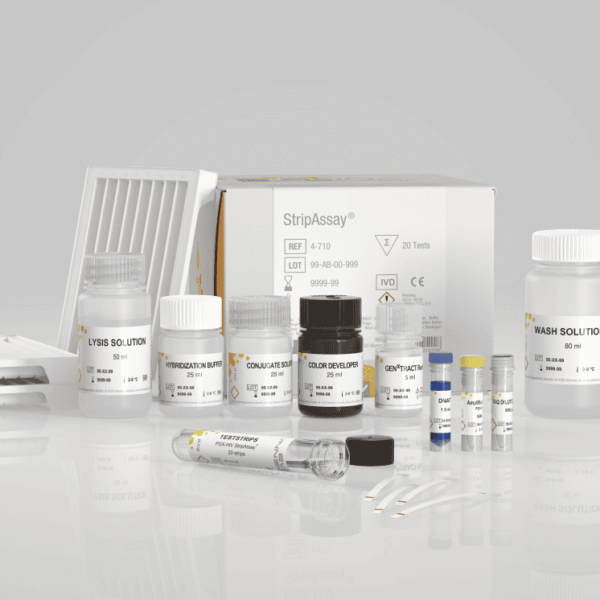
- Amplification Mix: Contains the necessary reagents for DNA amplification through PCR, including primers specific to the regions of interest.
- Hybridization Buffer: A solution that facilitates the binding (hybridization) of DNA to the probe.
- Strips: Contain immobilized oligonucleotide probes specific to the genetic variations of interest.
- Washing Solution: Used to remove unbound DNA after hybridization.
- Colorimetric or Fluorescent Detection Reagents: Used to visualize the hybridized DNA.
- Control Strips: These are used to ensure the test is working correctly by providing known positive and negative results.
- Detailed Instruction Manual: This will provide the user with step-by-step instructions on how to conduct the assay.
Datasheets and regulatory documentation
Everything your quality team needs for evaluation and procurement.
Instructions for Use
Frequently paired with this kit
Other assays and instruments lab teams add alongside the Thrombo Stripassay.

Add this kit to your quote
Tell us the platforms and throughput you’re planning for and our specialists will put together a clear proposal with the right documentation, no public pricing, just a considered answer.