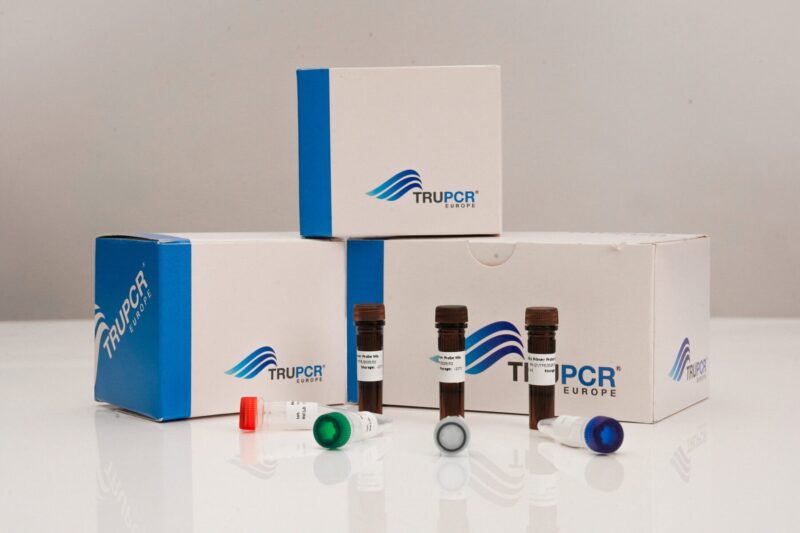
Rifampicin Resistant MTB Testing Kit, tap a thumbnail to see more views.
Rifampicin Resistant MTB Testing Kit
The TRUPCR® Rifampicin Resistant MTB Testing Kit is an in vitro real-time nested PCR assay intended for the qualitative detection of Mycobacterium tuberculosis complex (MTBC) and the determination of rifampicin resistance or susceptibility. The assay targets the 81-bp hotspot region of the rpoB gene, where the majority of rifampicin-associated mutations occur. Mutations within this region are widely recognized as a reliable molecular indicator for multi-drug resistant tuberculosis (MDR-TB). The kit uses a multi-tube format: one tube for MTBC detection and two tubes for screening mutations across the rpoB hotspot using five probes. These probes are designed to recognize wild-type sequences and detect deviations caused by single-nucleotide substitutions. An internal control is included in every reaction to assess sample adequacy and potential PCR inhibition. The nested PCR workflow enhances sensitivity, enabling detection from pulmonary and extrapulmonary samples, including those with low bacterial loads. The assay incorporates hot-start polymerase and UDG to improve analytical specificity and reduce contamination risk. The kit is compatible with standard real-time PCR instruments.
Quote-based, no public pricing. Add to your quote and our specialists put together a proposal with the right documentation, typically within 24 hours.
This kit in detail
- Nested real-time PCR detection of MTBC with rifampicin resistance assessment.
- Five rpoB hotspot probes enabling detection of known and unknown mutations.
- Hot-start and UDG-enabled workflow for improved specificity and contamination control.
- Compatible with routine real-time PCR platforms; validated for diverse sample types.
TRUPCR® Rifampicin Resistant MTB Testing Kit
The TRUPCR® Rifampicin Resistant MTB Testing Kit is an in vitro nucleic acid amplification assay designed for the qualitative detection of MTBC and the determination of rifampicin resistance or susceptibility. The assay applies real-time nested PCR to support detection in specimens with low bacterial load. The kit consists of multiple reaction tubes, including a tube dedicated to MTBC identification and tubes that interrogate the rpoB hotspot region associated with rifampicin resistance. The workflow is suitable for routine molecular testing using standard real-time PCR platforms.
Clinical Relevance of Rifampicin Resistance Targets
Rifampicin resistance in MTBC is primarily linked to mutations in an 81-base pair region of the rpoB gene (codons 507–533). More than 90% of rifampicin-resistant strains carry mutations in this region, making it a widely accepted molecular marker for MDR-TB screening. The assay uses five probes that collectively cover the defined hotspot. Detection of mutations suggests rifampicin resistance, while amplification of all probes within defined Ct thresholds supports susceptibility. These molecular findings should be interpreted in conjunction with clinical information, phenotypic testing, and other laboratory data.
About the Assay
The kit uses nested real-time PCR combined with fluorescent probe–based detection. During amplification, probes hybridize to target sequences within the rpoB region. Probe cleavage by DNA polymerase generates a fluorescence signal proportional to the presence of the target sequence. The assay includes an internal control in each reaction to monitor for inhibition and verify amplification validity.
The inclusion of a hot-start enzyme minimizes non-specific amplification, while UDG reduces the risk of carryover contamination by degrading uracil-containing amplicons. All reagents required for amplification are provided, and the workflow is compatible with routine laboratory equipment and standard DNA extraction methods.
Principle and Workflow
In the nested amplification process, target DNA undergoes two consecutive amplification stages within the same reaction setup, enhancing sensitivity. Fluorescent hydrolysis probes bind to the rpoB target region and are cleaved during polymerase extension, generating measurable signal.
The assay format includes:
- Tube 1: MTBC detection
- Tubes 2–3: Mutation screening using five rpoB probes
If a mutation disrupts probe binding, the affected probe will fail to amplify or show a ΔCt shift beyond defined thresholds, indicating potential resistance.
The workflow consists of sample processing, reaction preparation, real-time amplification, and fluorescence interpretation. The internal control ensures sample and amplification integrity.
Clinical Application
The kit is intended for qualitative detection of MTBC and assessment of rifampicin resistance in pulmonary and extrapulmonary samples. It is suitable for initial screening, rapid resistance assessment, and support of TB control programs. A rifampicin-susceptible result does not exclude the presence of other resistance mechanisms, and all results should be evaluated alongside phenotypic susceptibility testing and clinical context.
Datasheets and regulatory documentation
Everything your quality team needs for evaluation and procurement.
Product Catalogus
Frequently paired with this kit
Other assays and instruments lab teams add alongside the Rifampicin Resistant MTB Testing Kit.

Add this kit to your quote
Tell us the platforms and throughput you’re planning for and our specialists will put together a clear proposal with the right documentation, no public pricing, just a considered answer.