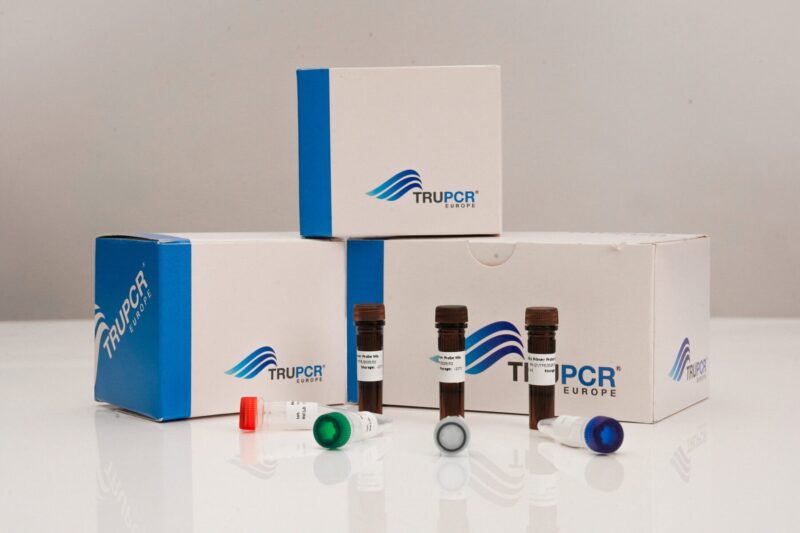
PML-RARA Qualitative PCR Test (BCR1, BCR2, BCR3), tap a thumbnail to see more views.
PML-RARA Qualitative PCR Test (BCR1, BCR2, BCR3)
The TRUPCR® PML-RARA Qualitative PCR Test (BCR1, BCR2, BCR3) is for the detection of the PML-RARA t(15;17) translocation is diagnostic for acute promyelocytic leukaemia (APL), although the diagnosis can also be based on morphology. Investigations suggest that 99% of APL patients harbour a translocation between chromosomes 15 and 17, which fuses the retinoic acid receptor alpha (RARA) gene on chromosome 17 with the PML gene on chromosome 15. Detection of the PML-RARA t (15;17) translocation is therefore used within clinical research as an identifier for APL. Depending on the location of breakpoints within the PML site, intron 6, exon 6 and intron 3, the respective PML-RARa transcript subtypes referred to as long (L or bcr1), variant (V or bcr2) and short (S or bcr3), may be formed. They represent 50-55%, 5-10% and 30-40% of the cases respectively. The TRUPCR® PML-RARA Qualitative PCR Test is an in vitro nucleic acid amplification assay for the qualitative detection of PML-RAR-alpha fusion transcripts in human clinical samples. In this multi-tube assay, extracted RNA is subjected to separate Real-time reverse transcription-polymerase chain reaction (RT-PCR) procedures to detect long, variant and short isoforms simultaneously. An additional amplification for the ABL gene is performed as a control for sample RNA quality.
Quote-based, no public pricing. Add to your quote and our specialists put together a proposal with the right documentation, typically within 24 hours.
This kit in detail
- Detects and differentiates BCR1, BCR2, and BCR3 PML-RARA fusion transcripts
- Identifies both 5’ and 3’ breakpoints in BCR2 variants
- ABL1 internal control included for RNA quality validation
- Reliable, high-specificity detection using probe-based RT-PCR
Qualitative PCR Detection of PML-RARA Fusion Transcripts in Acute Promyelocytic Leukemia (APL)
The TRUPCR® PML-RARA Qualitative PCR Test is a real-time RT-PCR assay developed for the qualitative detection and differentiation of PML-RARA fusion transcripts in bone marrow or peripheral blood samples of patients with acute promyelocytic leukemia (APL/AML-M3). This multi-tube assay identifies the three clinically relevant transcript variants-BCR1 (long form), BCR2 (variant form), and BCR3 (short form)-that arise from the t(15;17) chromosomal translocation. The kit also amplifies the ABL1 gene as an internal control for RNA integrity.
Based on oligonucleotide hydrolysis (TaqMan probe) technology, this assay delivers high specificity and sensitivity, supporting diagnosis, subtyping, and potential treatment response assessment.
Molecular Background
Acute promyelocytic leukemia (APL) is a genetically distinct subtype of AML that accounts for 10–15% of all AML cases. Nearly 99% of APL patients carry the t(15;17)(q24;q21) translocation, resulting in a PML-RARA gene fusion. This fusion alters transcriptional regulation and blocks promyelocyte differentiation, driving leukemogenesis.
Depending on the location of the PML gene breakpoint, one of three PML-RARA fusion transcripts is formed:
- BCR1 (long) – Intron 6 breakpoint (50–55% of cases)
- BCR2 (variant) – Exon 6 breakpoint (5–10%)
- BCR3 (short) – Intron 3 breakpoint (30–40%)
Recent evidence suggests that the type of fusion transcript may have prognostic and therapeutic implications. For instance, BCR3 is associated with shorter remission duration, while some BCR2 variants may respond less effectively to all-trans retinoic acid (ATRA), especially when the breakpoint lies 5’ to nucleotide 1709. Conversely, 3’ breakpoints in BCR2 may respond to ATRA similarly to BCR1 and BCR3.
Assay Performance & Utility
The TRUPCR® PML-RARA Qualitative PCR Test allows:
- Differentiation of BCR1, BCR2, and BCR3 isoforms in APL
- Detection of both 5’ and 3’ BCR2 breakpoints
- Sensitive RNA-based detection of the t(15;17) translocation
- Assessment of transcript subtype, aiding prognostic stratification
- Verification of RNA integrity via ABL1 internal control
This assay supports diagnosis, transcript typing, and potential response prediction, with fast turnaround and minimal hands-on time.
Technical Specifications
- Assay Type: Real-time RT-PCR (qualitative)
- Target Transcripts: PML-RARA BCR1, BCR2, BCR3
- Control Gene: ABL1 (for RNA quality assurance)
- Sample Type: RNA from peripheral blood or bone marrow
- Input Requirement: 50–200 ng total RNA per reaction
- Detection Format:
- Multi-tube for BCR1/BCR3
- Multi-dye probes (FAM, VIC, ROX) for BCR2 (5’/3’)
- Probe Chemistry: Fluorescent hydrolysis (TaqMan)
- Instrumentation: Compatible with ABI 7500, Bio-Rad CFX96™, Roche LightCycler®, and similar systems
Datasheets and regulatory documentation
Everything your quality team needs for evaluation and procurement.
Product Catalogus
Frequently paired with this kit
Other assays and instruments lab teams add alongside the PML-RARA Qualitative PCR Test (BCR1, BCR2, BCR3).


Add this kit to your quote
Tell us the platforms and throughput you’re planning for and our specialists will put together a clear proposal with the right documentation, no public pricing, just a considered answer.