Getting extraction input right before you commit an NGS run
NGS is only as good as what goes in. How nucleic-acid yield, purity and integrity shape library quality, and the pre-analytical checks worth running before you commit a flow cell.
Workflow note · Viennalab · 16S Microbiome + ITS NGS Assay
Method & sample types
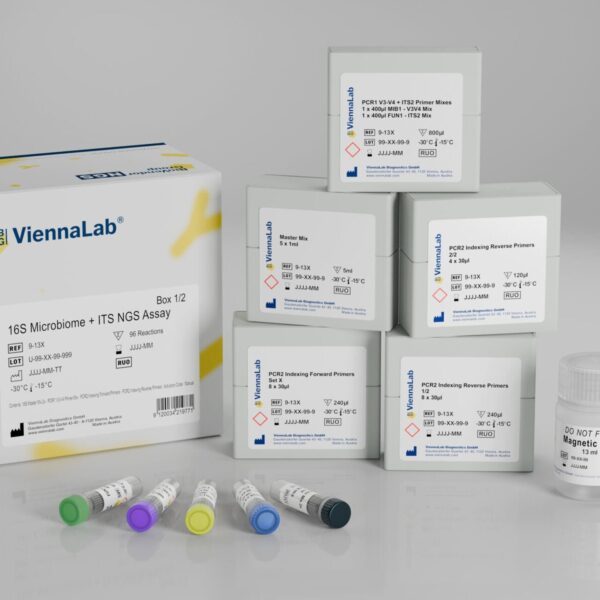
The Viennalab 16S Microbiome + ITS NGS Assay profiles bacterial (16S) and fungal (ITS) community composition from a single extracted nucleic-acid input. Because it is a sequencing-based assay rather than a single-target PCR, the quality of the extraction feeding into it has an outsized effect on the result: low-biomass or degraded input can skew community profiles in ways a single-target PCR would never reveal, simply by amplifying preferentially or dropping out low-abundance taxa.
Controls & interpretation
Pre-analytical QC, yield (concentration), purity (260/280 and 260/230 ratios) and integrity (fragment-size distribution), is worth checking on the extracted input before committing it to library preparation, since a failed or marginal run is far more expensive to discover after sequencing than before. A negative extraction control run alongside patient samples helps distinguish true low-abundance signal from reagent or environmental contamination, which is a well-known risk in low-biomass microbiome work.
Workflow integration
Building a pre-library QC checkpoint into the workflow, even a simple concentration and integrity check, catches the majority of samples that would otherwise produce an unusable or hard-to-interpret sequencing run. For labs new to NGS, this single step is usually the highest-value addition to an existing extraction-to-sequencing pipeline.
Products this note applies to
Request a quote or open the product page for the full specification and documentation.
Browse all products