Why broad antigen coverage matters in European Lyme serology
Because European Lyme borreliosis is caused by several Borrelia genospecies whose antigens differ enough to change what an assay detects, the Microblot-Array Borrelia IgG and IgM assays present nineteen Borrelia antigens with VlsE, OspA and OspC in multiple genospecies variants, alongside three Anaplasma phagocytophilum antigens and a built-in cross-reactivity control, read quantitatively from triplicate microdots.
Serology remains the backbone of laboratory diagnosis of Lyme borreliosis, and its weakness is well documented. Two-tier testing has a sensitivity of only 30 to 40 per cent during early infection, rising to 70 to 100 per cent once the disease has disseminated [1]. European data show the same gradient: antibody detection rates of 20 to 50 per cent in localised disease, 70 to 90 per cent in early disseminated disease and close to 100 per cent in late disease [2].
That gap is only partly a matter of timing. A significant part of it is a matter of which antigens the assay presents. An assay can only detect antibodies against the antigens it carries, in the variants it carries them. In Europe this is not a detail, because European Lyme borreliosis is caused by several genospecies whose surface proteins differ substantially from one another.
Why one genospecies is not enough in Europe
Borrelia afzelii, B. garinii and B. burgdorferi sensu stricto are all confirmed agents of Lyme borreliosis in Europe, and B. spielmanii has been detected in early skin disease [3, 4]. They are not interchangeable at the antigen level:
- OspC shows sequence heterogeneity of up to 40 per cent depending on the genospecies [5]. A comparison of recombinant OspC from the three main genospecies found stronger reactivity against OspC from B. afzelii and B. garinii than from B. burgdorferi sensu stricto, and concluded that a polyvalent antigen with several OspC variants from at least B. afzelii and B. garinii is needed to improve sensitivity [6].
BmpA (p39) gives a threefold difference in yield depending on which genospecies it comes from. IgG sensitivity across stages I to III was 36.0 per cent with B. afzelii BmpA and 34.9 per cent with B. garinii BmpA, against 13.9 per cent with BmpA from B. burgdorferi sensu stricto [7].
DbpA (p17) falls into five genospecies-linked groups sharing only 44 per cent amino acid identity, and the variants complement one another in their reactivity [8].
VlsE is the most sensitive single antigen for IgG detection [9], but its antigenicity is not uniform across strains. Which homologue is used measurably changes performance: in a recombinant line immunoblot, VlsE from B. garinii strain PBi gave the highest sensitivity [10]. Adding VlsE and a B. garinii DbpA homologue to a recombinant IgG immunoblot raised sensitivity in early neuroborreliosis from 52.7 to 86.1 per cent [11].
The clinical picture in Europe compounds this. Skin isolates are dominated by B. afzelii and cerebrospinal fluid isolates by B. garinii, while Lyme arthritis is genospecies-heterogeneous: an ospA-typing study of synovial fluid found type 1 in 26.6 per cent, type 2 in 33.3 per cent, type 4 in 6.6 per cent and type 5 in 33.3 per cent of cases [12]. A laboratory cannot predict from the referral which genospecies it is testing against.
The Microblot-Array Borrelia assays carry the relevant antigens in multiple genospecies variants: VlsE from B. afzelii, B. garinii and B. burgdorferi sensu stricto; OspA from all three; OspC from all three plus B. spielmanii; p41 from B. afzelii and B. burgdorferi sensu stricto; together with p83, p58, p39, OspB, OspE, NapA and p17. Nineteen Borrelia antigens in total [13].
Covering the whole disease course, not one stage
Antigen breadth also buys stage coverage, which is why the IgG and IgM assays are best read as one system.
OspC is the most sensitive antigen for IgM detection and VlsE the most sensitive for IgG [9], so the early and the established response are addressed by different spots on the same array. Antibodies to p58 and p17 measurably improve IgG sensitivity in stage II and stage III disease [14]. OspA and OspB sit at the other end of the course again: OspA is expressed by spirochaetes in the unfed tick and is largely downregulated in the mammalian host, where OspC is upregulated instead [15], and strong IgG responses to OspA and OspB have been described at the beginning of prolonged episodes of Lyme arthritis while being absent in patients with erythema migrans or meningitis [16]. Presenting all of these on one array means the same test is informative in an early and a late presentation, rather than being optimised for one of them.
The independent diagnostic contribution of OspE and NapA in European cohorts is less well characterised than that of the antigens above, and neither appears in the standardised European immunoblot criteria. They should be read as supporting spots, not as decision drivers.
Built-in control for the two classic cross-reactivities
Flagellin p41 is the most productive source of false positives in Lyme serology. Antibodies to it are common in people without Lyme borreliosis: in one control panel 41.8 per cent of 129 non-Lyme control sera carried IgG anti-p41, and an isolated p41 band was by far the most frequent pattern seen [17]. The structural reason is known. The epitopes that bind human antibodies specifically in Lyme borreliosis lie in the central, non-conserved portion of the molecule, whereas sera from patients with syphilis bind strongly to the amino-terminal conserved domain [18]. Syphilis sera are correspondingly the worst offenders on Lyme immunoblots, with 88.2 per cent showing bands in one cross-reactivity panel [17].
The Microblot-Array design addresses this on the array itself rather than leaving it to the reader:
- The IgG array carries recombinant TpN17, a Treponema pallidum-specific lipoprotein (TP0435) used as a recombinant antigen in syphilis serology, to flag reactivity attributable to T. pallidum [13].
The IgM array carries EBV VCA-p18 for the same purpose against Epstein-Barr virus, the other classic source of false-positive IgM through polyclonal B-cell stimulation [13].
This is a design feature, not a validated exclusion algorithm: the intended use is described in the published literature [13], but no study has yet quantified how well an in-panel TpN17 or VCA-p18 spot performs as a cross-reactivity filter. It should be used as it is intended, as information that prompts targeted syphilis or EBV serology, not as a substitute for it.
Anaplasma phagocytophilum on the same array
A. phagocytophilum shares its vector with Borrelia, and the two are co-transmitted more often than chance would predict: a pooled analysis reported co-infection prevalence up to 28 per cent in ticks and 67 per cent in vertebrates [19]. Clinically confirmed human co-infection is much rarer than serological co-reactivity, and a systematic review of 655 possible cases found no impact on severity [20], which is precisely why a serological flag is useful rather than alarming.
The arrays carry three A. phagocytophilum antigens: p44, the immunodominant major surface protein encoded by a hypervariable paralogous gene family; OmpA; and Asp62 (APH_0404), a surface-exposed protein recognised by patient serum [21]. This exact three-antigen combination has been used in a published paediatric immunoblot study, which found 2.0 per cent IgM and 2.4 per cent IgG positivity among tick-borne disease patients, significantly above blood donors [22].
Format: quantitative reading instead of band interpretation
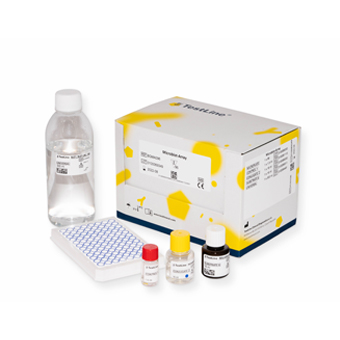
Recombinant antigens are applied as microdots in triplicate on a nitrocellulose membrane in a microtitre well, with control spots for functionality and conjugate presence, positive controls, and calibration spots for quantitative evaluation, in every individual well. Reading is done by the Microblot-Array reader and software rather than by eye.
This matters more than it sounds. Visual interpretation of Lyme immunoblots is subjective and varies considerably between laboratories: a proficiency testing programme covering German and other European laboratories found reporting of specific immunoblot bands to be highly variable and clearly correlated with manufacturer and methodology [23], and a comparison of eight ELISAs and immunoblots found at best moderate agreement between blots, concluding that exchanging results between laboratories using different methodologies is hazardous [24]. Quantitative readout is not merely more convenient. Applying quantitative interpretation criteria to array and bead formats, specifically treating a strong singular IgG reaction against VlsE as positive, raised sensitivity from 32 to 85 per cent without a significant loss of specificity [25].
Practical characteristics: 96 tests per kit, total assay time approximately 1.5 hours, all reagents ready to use, sequential use possible for small batches, storage at 2 to 8 °C. Validated sample types are serum, plasma, cerebrospinal fluid and synovial fluid, with dilutions of 1:51, 1:3 and 1:17.5 respectively.
Where it fits in the algorithm
The assays are intended as a confirmatory test following ELISA, in line with the two-tier structure used across European and North American guidance [26]. Two points from the ESCMID position paper are worth restating because they determine whether any confirmatory assay adds value: typical erythema migrans should be diagnosed clinically and does not require laboratory testing, and testing individuals with non-specific subjective symptoms is not recommended because of the low positive predictive value [27].
What this note does not claim
No independent diagnostic accuracy study of the Microblot-Array Borrelia IgG or IgM assay has been published to date. The published literature describes the antigen composition [13]; the performance evidence cited here concerns the antigens and the assay format, not this kit as a finished product. Laboratories should verify performance locally against their own reference algorithm before adopting it, as they would for any new confirmatory assay.
Serology, whatever its antigen breadth, cannot distinguish active from past infection, and IgM results in particular should be interpreted alongside clinical presentation and duration of symptoms.
—
Product details
| | |
|—|—|
| Microblot-Array Borrelia IgG | Cat. BGMA096, 96 tests, EAN 8595635306600 |
| Microblot-Array Borrelia IgM | 96 tests |
| Manufacturer | TestLine Clinical Diagnostics s.r.o. |
| Technique | Microblot-Array |
| Samples | Serum, plasma, cerebrospinal fluid, synovial fluid |
| Storage | 2 to 8 °C |
| Regulatory status | CE-IVD |
For instructions for use, the Declaration of Conformity, or to discuss local verification, [please do not hesitate to contact us](mailto:sales@goffinmt.com).
—
References
1. Moore A, et al. Current guidelines, common clinical pitfalls, and future directions for laboratory diagnosis of Lyme disease, United States. *Emerg Infect Dis.* 2016;22(7):1169-77. PMID 27314832.
2. Wilske B, et al. Microbiological and serological diagnosis of Lyme borreliosis. *FEMS Immunol Med Microbiol.* 2007;49(1):13-21. PMID 17266710.
3. Stanek G, Reiter M. The expanding Lyme Borrelia complex: clinical significance of genomic species? *Clin Microbiol Infect.* 2011;17(4):487-93. PMID 21414082.
4. Richter D, et al. Delineation of Borrelia burgdorferi sensu lato species by multilocus sequence analysis and confirmation of the delineation of Borrelia spielmanii sp. nov. *Int J Syst Evol Microbiol.* 2006;56(Pt 4):873-881. PMID 16585709.
5. Rauer S, et al. Enzyme-linked immunosorbent assay using recombinant OspC and the internal 14-kDa flagellin fragment for serodiagnosis of early Lyme disease. *J Clin Microbiol.* 1998;36(4):857-61. PMID 9542898.
6. Panelius J, et al. Recombinant OspC from Borrelia burgdorferi sensu stricto, B. afzelii and B. garinii in the serodiagnosis of Lyme borreliosis. *J Med Microbiol.* 2002;51(9):731-739. PMID 12358063.
7. Roessler D, et al. Heterogeneity of BmpA (P39) among European isolates of Borrelia burgdorferi sensu lato and influence of interspecies variability on serodiagnosis. *J Clin Microbiol.* 1997;35(11):2752-8. PMID 9350727.
8. Schulte-Spechtel U, et al. Molecular analysis of decorin-binding protein A (DbpA) reveals five major groups among European Borrelia burgdorferi sensu lato strains with impact for the development of serological assays and indicates lateral gene transfer of the dbpA gene. *Int J Med Microbiol.* 2006;296 Suppl 40:250-66. PMID 16530482.
9. Wilske B. Epidemiology and diagnosis of Lyme borreliosis. *Ann Med.* 2005;37(8):568-79. PMID 16338759.
10. Goettner G, et al. Improvement of Lyme borreliosis serodiagnosis by a newly developed recombinant IgG and IgM line immunoblot assay and addition of VlsE and DbpA homologues. *J Clin Microbiol.* 2005;43(8):3602-9. PMID 16081885.
11. Schulte-Spechtel U, et al. Significant improvement of the recombinant Borrelia-specific IgG immunoblot test by addition of VlsE and a DbpA homologue derived from Borrelia garinii for diagnosis of early neuroborreliosis. *J Clin Microbiol.* 2003;41(3):1299-303. PMID 12624072.
12. Vasiliu V, et al. Heterogeneity of Borrelia burgdorferi sensu lato demonstrated by an ospA-type-specific PCR in synovial fluid from patients with Lyme arthritis. *Med Microbiol Immunol.* 1998;187(2):97-102. PMID 9832323.
13. Szewczyk-Dabrowska A, et al. Correlation between COVID-19 severity and previous exposure of patients to Borrelia spp. *Sci Rep.* 2022;12(1):15944. PMID 36153350.
14. Wilske B, et al. An improved recombinant IgG immunoblot for serodiagnosis of Lyme borreliosis. *Med Microbiol Immunol.* 1999;188(3):139-44. PMID 10776844.
15. Schwan TG, et al. Induction of an outer surface protein on Borrelia burgdorferi during tick feeding. *Proc Natl Acad Sci USA.* 1995;92(7):2909-13. PMID 7708747.
16. Kalish RA, et al. Association of treatment-resistant chronic Lyme arthritis with HLA-DR4 and antibody reactivity to OspA and OspB of Borrelia burgdorferi. *Infect Immun.* 1993;61(7):2774-9. PMID 7685738.
17. Hernandez-Novoa B, et al. Utility of a commercial immunoblot kit (BAG-Borrelia blot) in the diagnosis of the preliminary stages of Lyme disease. *Diagn Microbiol Infect Dis.* 2003;47(1):321-9. PMID 12967745.
18. Jiang W, et al. Mapping the major antigenic domains of the native flagellar antigen of Borrelia burgdorferi. *J Clin Microbiol.* 1992;30(6):1535-40. PMID 1378061.
19. Nieto NC, Foley JE. Meta-analysis of coinfection and coexposure with Borrelia burgdorferi and Anaplasma phagocytophilum in humans, domestic animals, wildlife, and Ixodes ricinus-complex ticks. *Vector Borne Zoonotic Dis.* 2009;9(1):93-102. PMID 18789001.
20. Boyer PH, et al. Human co-infections between Borrelia burgdorferi sl and other Ixodes-borne microorganisms: a systematic review. *Pathogens.* 2022;11(3):282. PMID 35335606.
21. Ge Y, Rikihisa Y. Identification of novel surface proteins of Anaplasma phagocytophilum by affinity purification and proteomics. *J Bacteriol.* 2007;189(21):7819-28. PMID 17766422.
22. Krbkova L, et al. Assessment of antibodies against surface and outer membrane proteins of Anaplasma phagocytophilum in Lyme borreliosis and tick-borne encephalitis paediatric patients. *Epidemiol Infect.* 2016;144(12):2597-604. PMID 27180603.
23. Hunfeld KP, et al. Quality of Lyme disease serology. Lessons from the German Proficiency Testing Program 1999-2001. A preliminary report. *Wien Klin Wochenschr.* 2002;114(13-14):591-600. PMID 12422607.
24. Ang CW, et al. Large differences between test strategies for the detection of anti-Borrelia antibodies are revealed by comparing eight ELISAs and five immunoblots. *Eur J Clin Microbiol Infect Dis.* 2011;30(8):1027-32. PMID 21271270.
25. Hauser U, et al. Modified interpretation criteria significantly improve performance of commercially available confirmatory assays for the serodiagnosis of Lyme borreliosis. *Eur J Clin Microbiol Infect Dis.* 2019;38(3):529-39. PMID 30715667.
26. Eldin C, et al. Review of European and American guidelines for the diagnosis of Lyme borreliosis. *Med Mal Infect.* 2019;49(2):121-132. PMID 30528068.
27. Dessau RB, et al. To test or not to test? Laboratory support for the diagnosis of Lyme borreliosis: a position paper of ESGBOR, the ESCMID study group for Lyme borreliosis. *Clin Microbiol Infect.* 2018;24(2):118-124. PMID 28887186.
Products this note applies to
Request a quote or open the product page for the full specification and documentation.
Browse all products